
Volatility in Backtesting: What It Really Tells You
If you run backtests regularly, you have seen this: Strategy A and B end with similar returns, but one feels much harder to hold in live trading. That gap is often volatility.
Volatility is not a beginner-only metric. It is one of the fastest ways to judge whether a strategy is realistically tradable for your risk tolerance.
What volatility measures and what it does not
Volatility measures the typical spread of returns over time.
It does not directly tell you:
- whether a strategy is profitable long term,
- how deep the worst loss was (max drawdown),
- whether downside moves dominate upside moves.
So volatility is essential, but strongest when read with other risk metrics.
Common misreads in backtests
-
"High volatility means bad strategy" Not always. Some momentum and trend-following systems intentionally accept higher volatility for stronger upside.
-
"Low volatility means safe" Also not always. A strategy can look calm for years and still break hard in a regime shift.
-
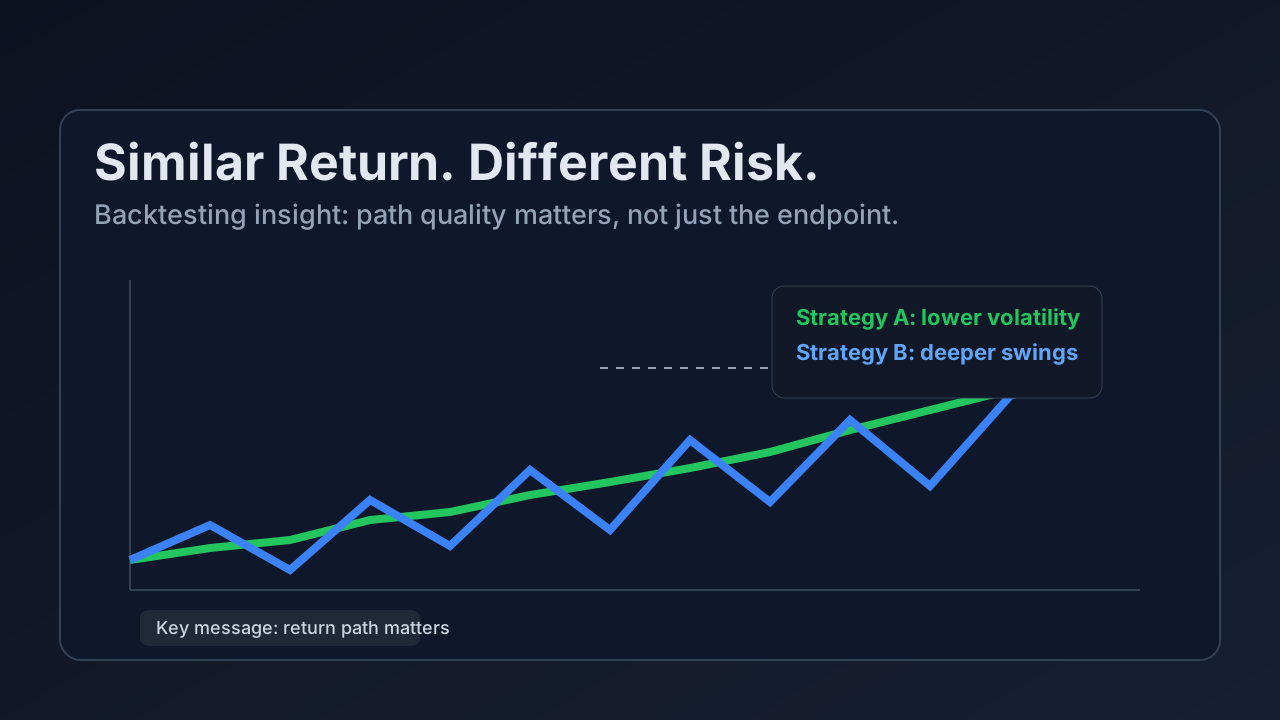
"Same CAGR means same quality" No. Two strategies can both deliver 10% CAGR while one has significantly higher stress, deeper drawdowns, and lower live-holdability.
How we use volatility in the report
We treat volatility as part of a risk stack:
- Full-period volatility for baseline risk.
- Rolling volatility to detect regime changes.
- Volatility next to drawdown and risk-adjusted ratios (for example Sharpe).
Practical benefit for you:
- You can see whether returns were "bought" with unstable risk.
- You can compare strategies across calm and stress phases.
- You can pick systems you can realistically stick with in live markets.
Example: Similar return, different risk profile
In the chart below, both strategies finish at a similar level. Strategy B, however, carries meaningfully higher rolling volatility and larger swings along the path.
Quick checklist for better strategy selection
- Never compare CAGR alone. Always include volatility and max drawdown.
- Prefer rolling volatility over one single full-period number.
- Validate behavior in stress regimes, not just in average years.
- Use Sharpe/Sortino as a second layer, not as a replacement for volatility.
Bottom line
In backtesting, volatility is a reality filter. It tells you how expensive your return was in terms of uncertainty. Read it together with drawdown and regime behavior, and your strategy decisions get meaningfully more robust.
Advanced Backtesting Notes
- Check whether volatility spikes are concentrated in a few crisis windows or persistent across regimes.
- Compare rolling windows (for example 6m and 12m), not only one full-period number.
- Pair volatility with max drawdown and recovery time to judge live holdability.
- Avoid overfitting to calm historical periods.